
Optimizing Air Mixing Box
Optimizing Air Mixing Box Design with Python and SolidWorks Simulation
Introduction
Air mixing boxes play a crucial role in ensuring efficient airflow management in various engineering applications. They help in blending multiple air streams at different temperatures to achieve uniform thermal distribution. In modern engineering, numerical simulations and computer-aided design (CAD) tools have become essential for optimizing the performance of these systems. This article explores a combined approach using Python for computational modelling and SolidWorks for advanced fluid flow visualization to enhance air mixing box efficiency.
Computational Modeling with Python
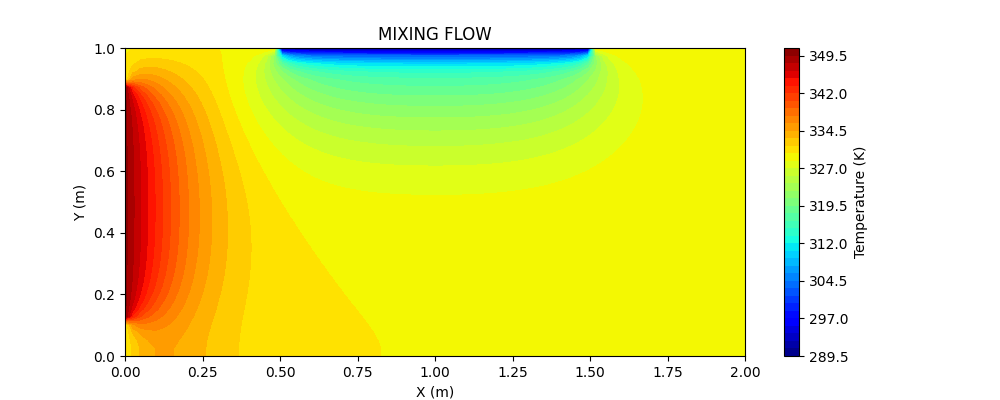
Numerical simulations provide a powerful way to predict airflow patterns, temperature distribution, and efficiency of an air mixing box. By leveraging a custom-built Python model, it is possible to analyse airflow behaviour and thermal mixing without relying on time-consuming physical testing.
The Python simulation applies advanced numerical techniques to model airflow dynamics, capturing the interaction between different air streams. By carefully defining the airflow parameters, inlet configurations, and computational grid, it allows engineers to visualize how air enters, mixes, and exits the system. The simulation results provide key insights into temperature uniformity, flow characteristics, and potential design improvements.
Key outcomes of the computational modelling include:
- Identification of regions with uneven thermal mixing.
- Analysis of flow distribution for optimizing inlet positioning.
- Prediction of energy efficiency improvements based on airflow behavior.
Advanced Airflow Simulation with SolidWorks
While Python provides an efficient numerical approach, detailed three-dimensional simulations enhance the understanding of real-world airflow dynamics. SolidWorks Flow Simulation is an advanced CFD tool that allows for precise airflow visualization, offering engineers a comprehensive view of how different air streams interact inside the mixing box.
The 3D design of the air mixing box is developed using CAD modelling techniques, incorporating optimal inlet and outlet configurations to enhance airflow blending. The simulation within SolidWorks provides a realistic representation of:
- Flow patterns and turbulence inside the box.
- Temperature distribution as air streams combine.
- Pressure variations that influence system performance.
By using visual representations such as streamlines and contour plots, engineers can gain valuable insights into optimizing the design for better thermal efficiency.
Advantages of Combining Python and SolidWorks for Air Mixing Optimization
The combination of numerical simulations and CAD-based airflow modelling presents several advantages:
- Early-Stage Design Evaluation: Python models allow rapid prototyping and initial testing before committing to full-scale CFD analysis.
- Cost and Time Efficiency: Reducing reliance on physical prototypes and extensive CFD calculations saves both time and resources.
- Enhanced Performance Insights: Python simulations highlight preliminary thermal characteristics, while SolidWorks provides a more detailed aerodynamic assessment.
This integrated approach enables engineers to refine air mixing box designs efficiently, improving energy efficiency and overall system performance.
Conclusion
Leveraging both computational modelling in Python and fluid simulations in SolidWorks provides a robust framework for optimizing air mixing box designs. This method ensures that the system operates efficiently, minimizing energy loss while maximizing uniform airflow distribution. By integrating digital simulations into the design process, engineers can create highly effective air management solutions that meet modern efficiency standards. Future advancements may include AI-driven optimization techniques to further enhance performance and adaptability in real-world applications.