
Pipe Insulation
Analysis of Heat Transfer Through an Insulated Pipe
Introduction
Pipe insulation is essential in minimizing heat transfer losses and improving energy efficiency in industrial and HVAC applications. Without proper insulation, significant thermal energy escapes, leading to higher operational costs and reduced system performance. This analysis explores how pipe insulation affects heat loss, determines the critical insulation thickness, and evaluates its role in thermal management.
Understanding Heat Transfer in Pipe Insulation
Heat transfer in an insulated pipe occurs through conduction, convection, and radiation. The efficiency of insulation depends on:
- Thermal conductivity of the insulation material.
- Convective heat transfer coefficient between the pipe’s surface and surrounding air.
- Inner and outer pipe radii, which determine insulation thickness.
- Temperature difference between the internal fluid and external environment.
1. System Overview: How Pipe Insulation Works
The system consists of a cylindrical pipe carrying a hot fluid at a high temperature. The heat from the fluid is transferred to the surrounding air through the pipe walls and insulation. The rate of heat loss depends on:
- Thermal conductivity of the insulation (how well the material resists heat flow).
- Convective heat transfer coefficient (how efficiently heat is removed from the pipe’s surface by the surrounding air).
- Inner and outer pipe radii (defining the thickness of insulation).
- Temperature difference between the fluid inside the pipe and the external environment.
2. Key Calculations and Insights
- Determining the Outer Radius of Insulation
- The insulation thickness is determined by balancing conduction (heat moving through the material) and convection (heat being removed by the surrounding air).
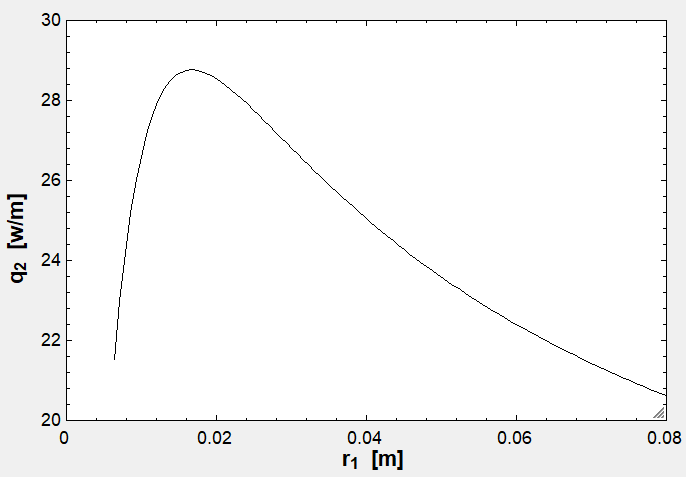
- A critical insulation thickness exists where increasing insulation can initially increase heat loss due to enhanced convection. Beyond this point, additional insulation significantly reduces heat loss.
- Effect of Insulation on Heat Loss
- The initial heat loss is calculated without additional insulation.
- A second case evaluates heat loss after increasing insulation thickness.
- If the heat loss is lower in the second case, it confirms the effectiveness of the insulation.
- Heat Transfer at the Pipe’s Inner Surface
- Heat transfer inside the pipe is also analyzed to determine how efficiently energy is moving from the fluid to the pipe walls.
- Comparing internal and external heat losses helps identify thermal bottlenecks in the system.
3. Practical Interpretation of Results
- If the outer radius of the insulation is greater than the critical value, heat loss decreases, making the insulation effective.
- If the outer radius is smaller than the critical value, adding insulation may initially increase heat loss due to stronger convection effects.
- Comparing heat loss before and after insulation confirms whether additional insulation is beneficial or if further adjustments are needed.
” Inputs “
k = 0.05
h_1= 3
T_1 = 200
T_2 = 20
r_i = 0.00635
“r_1 = 0.03”
” equation “
r_o = k / h_1
T_Ins = (r_o – r_i) * 100
q_1 = 23.14(T_1 – T_2) / (( ln(r_o/r_i) / k) + 1/(r_o * h_1))
q_2 = 23.14(T_1 – T_2) / (( ln(r_1/r_i) / k) + 1/(r_1 * h_1))
q_4 = h_1 * 2 * 3.14 * r_i * (T_1 – T_2)
4. Applications in Engineering
This analysis is widely used in:
- Industrial steam pipelines to reduce energy loss.
- HVAC ductwork for efficient thermal management.
- Refrigeration and cooling systems to prevent heat gain.
- Boilers and heat exchangers where temperature control is critical.
By optimizing insulation thickness, engineers can improve energy efficiency, reduce operational costs, and enhance system performance.